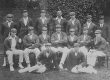
Ronald Werner died on Tuesday 6th January 2026 at Royal North Shore Hospital at age 94. Ron had been suffering from Alzheimer’s disease for several years. I met with Ron in May 2024 when researching for my book “Service and Sacrifice- The Gordon District Cricket Club in the Second World War”. His memories of playing with Gordon District Cricket Club were very clear.
I wrote the following chapter about Ron, his career and his memories of the Gordon players of the day.
A CONVERSATION WITH RON WERNER – HE WAS THERE
It is not often you get the chance to meet with a person who played cricket with many of the players in this book. That privilege came about through a meeting with Ron Werner and his son Greg shortly before Christmas in 2023. Ron is ninety three years old and played for Gordon’s A W Green Shield team in the first three years after the war from 1944 to 1947 as a fast bowler. He followed this with a short season in the Poidevin-Gray team before joining the Gordon Shires team for the 1947-48 season.
The Annual Report commented about the young Ron:
R Werner, who is captain of the North Sydney Boys high School 1st XI, played several matches in this grade and secured 14 wickets at 10.14. For the last round he was promoted to the second XI, where he performed with success, making 34 not out and taking 3 for 42.
Ron played four more seasons with the club making his debut for First Grade in 1948-49 and taking 133 wickets in all grades at 15.76. Ron’s performances in the 1950-51 season were particularly noteworthy when, after not playing to his best form the season before, volunteered to be chosen in the Fourth Grade team to ‘regain his form’ taking 42 wickets at an incredible average of 7.60 over six games. Ron also took 14 wickets in one match which remains the record for most wickets in a match for Gordon. It was obvious Ron was a better cricketer than Fourth Grade and was duly promoted. Ron moved twice after the 1950-51 season and due to residential rules also played with North Sydney and Northern Districts.
It was obvious Ron didn’t want to talk about his career at Gordon when I started the meeting by offering to show him his record with the club. He replied:
That must be a short document.
That gave me the immediate hint I would be in for an interesting discussion.
My first topic was Ray Robinson who had suffered so much during the war and I wanted to know about how the other players felt about him.
He was a very nervous person, he constantly moved about fiddling with a cricket ball to try and settle his nerves. We all knew he had suffered from shell shock during the war, and we knew alcohol was a means to help him get through a difficult time. Ray was always very good to me as a young player and I went to his home often on Sunday mornings for practice sessions.
As a former fast bowler, it didn’t take long to talk about other fast bowlers in the club. My mention of Sir Lincoln Carruthers (Bob) Hynes, a Gordon player with 370 wickets and numerous caps for NSW, prompted an immediate comment.
I wouldn’t have called him FAST. We used to call him ‘Elsie (LC)’.
That gave me concern in bringing up Ginty Lush, the Gordon First Grade captain of two premiership teams and First Class allrounder. Ron’s reply, however, was quite different:
Ginty was quite quick off a short run up and bowled outswingers with a bit of life off the wicket. I can see him now approaching the wicket. He was very athletic.
Our next victim was Basil Sheidow. ‘You mean the air force man’ was Ron’s first comment. ‘He was a very dapper man and a handy player’ – high praise from Ron. When I relayed the story that Basil actually went to the war as a medical orderly and while he was officially in the air force, he didn’t fly or be part of an aircrew at any stage. ‘That sounds just like Bas’ was Ron’s pointed reply.
To change the subject, I then asked what he remembered about Jock Shea who played from 1932 to 1952 and scored 5,896 runs for the club. ‘Just an average cricketer’ was Ron’s reply. I would suggest that comment might have come from many sessions in the nets bowling to Jock. I was now apprehensive to ask about Sid Carroll, but Ron was right on queue.
He was a lovely bloke. The best of the whole bunch. He was always helpful to the younger players and was an excellent cricketer. He and Jack Potter were a great opening pair for Gordon and a pleasure to watch.
Ron also remembered Col Alderdice very well as he had played a lot of cricket with Col from 1947 to 1950 in lower grades where Col had been a prolific wicket taker. When I asked why he didn’t play more first grade I got the answer I suspected. ‘He had Reg Giddey and Jack Pettiford above him’ was the immediate answer. He then volunteered,
Did you know that Reg Giddey had a very round arm action. He would come in to bowl with his arm out wide from his body and kept it out there when he bowled the ball.
It was now time to talk about someone closer to Ron’s age like Charlie Trumper who was also a member of Gordon’s own Royal family being Victor’s nephew.
A North Sydney Boys High boy, he liked to PLAY UP A BIT and he TRIED to bowl fast.
There were other players Ron remembered well whom he enjoyed playing cricket with, such as Dave Evans, Jack Quigley, George Wearne, Bob Lowing and another ‘medium’ paced bowler Stan Lewis. He also had fond memories of the club secretary, Paul Harrison.
An important double barrelled question to complete a very enjoyable conversation was ‘Did the players consider they were going on an adventure when they enlisted in the war or were they worried and did they talk about it much after the war’. Ron’s answer was interesting and insightful.
It was a bit of both, but the main difference was that the threat was very close to home. My father spent a lot of time digging trenches in the local school yard to protect us against possible air raids and we were regularly doing air raid drills.
The threat was very close to home and the players knew it was their duty. On their return, they would never talk about the war, you could only find out information from second hand conversations.
Ron’s father Walter Werner also served in the First World War from September 1916 till the end of the war in 1918 with both the 38th Battalion in several battles in the Somme region and as a Senior Mechanical Transport Officer for the 5th Motor Transport Company. He was also an accomplished cricketer having a particular day out playing for Mudgee against Bathurst when he scored 101 not out with 12 sixes in 22 minutes.
Thank you, Ron; it was a great chat and gave an insight that record books cannot express.
Paul Stephenson